Short answer: yes—DIY winterization can affect warranties, but it depends on the brand and installer terms. Many manufacturer and labor warranties require professional service, proof of maintenance, and approved parts. If you winterize yourself and something fails, a claim can be denied. Still, some warranties allow DIY if you follow documented procedures and keep records.
What you’ll learn from this blog
- Which warranties are most affected by DIY winterization
- What the fine print usually requires to keep coverage
- How to DIY without accidentally voiding your warranty
- Documentation and proof insurers and manufacturers actually accept
- When hiring a pro is the safer (and cheaper) move, you can compare service costs and understand what protection you’re really paying for.
The fine print that decides everything (and how to read it fast)
Think of a warranty like a safety net: it works, but there are holes—“exclusions,” “improper use,” and “unauthorized service.” For lawn and irrigation systems, two kinds of coverage matter most:
- Manufacturer parts warranty: Often requires following the owner’s manual, using approved parts, and never exceeding recommended pressures.
- Installer or labor warranty: Frequently requires professional winterization or at least proof that the system was serviced correctly and on time.
Quick win: scan for phrases like “must be installed/serviced by an authorized professional,” “improper maintenance,” “use of non-approved materials,” and “proof of service required.” Those lines are where DIY can trip you up.
Real-world example: A homeowner used a small pancake compressor to blow out sprinklers. It ran at high PSI with low airflow, leaving water pockets behind. A cold snap cracked the manifold. The labor warranty was denied due to “improper winterization.” A 0DIYdecisionturnedintoa1,100 repair.
DIY winterization that doesn’t tank your coverage
You can still do it right—just be intentional. Before you grab the air hose, protect your warranty like you’d protect your pipes.
-
Confirm the rules:
- Check both the manufacturer and installer warranties.
- Look for any requirement for licensed or “authorized” service.
- Some municipalities require certified backflow testing; DIY won’t satisfy that.
-
Use the right equipment and settings:
- Use a compressor with enough airflow (CFM), not just high PSI. Many brands suggest moderate pressure (often in the 50–80 PSI range) and cycling zones briefly to avoid heat damage.
- Never use automotive antifreeze in irrigation lines—it’s unsafe and will likely void coverage.
-
Document like a pro:
- Save receipts for parts, O-rings, filters, and compressor rental.
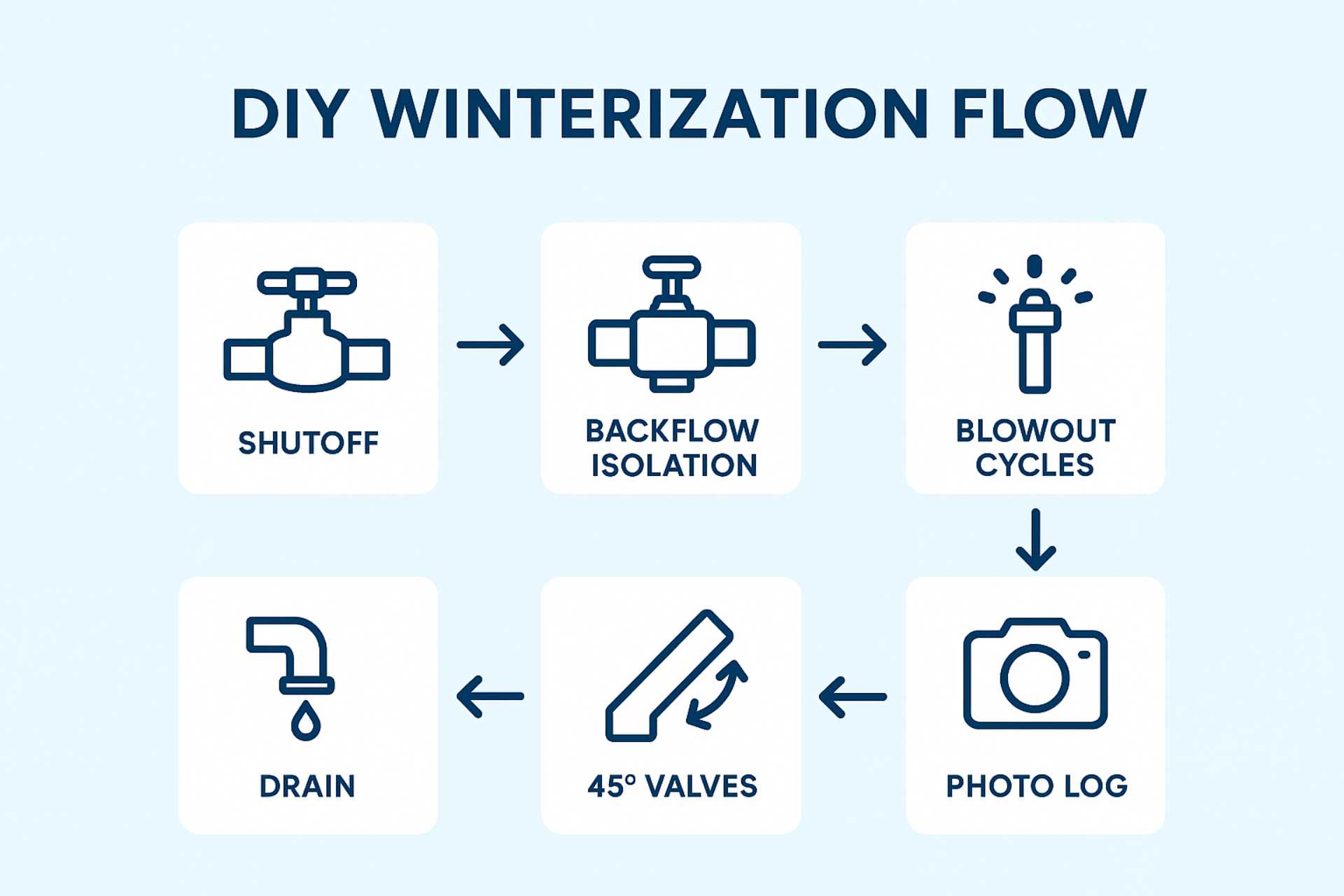
- Take time-stamped photos: shutoff valve closed, backflow drained, zones blown out (spray location, mist clearing), controller set to winter/off mode.
- Keep a simple checklist with date/time and steps completed.
-
Know the no-go zones:
- Backflow preventers often require certified testing.
- Gas-powered heaters, boilers, and pumps may need a licensed technician to keep coverage intact.
Quick checklist to protect your warranty before you DIY
- Find and save your warranty PDFs (brand + installer)
- Confirm whether professional service is required
- Follow the manual’s winterization steps
- Use approved parts and safe pressure ranges
- Photograph each step and keep receipts
- Record date/time and the zones you blew out
- Schedule backflow testing if your city requires it
The moments when a pro saves you money (yes, really)
Sometimes the cheapest path is hiring the expert. If your system has:
- Complex manifolds, older poly lines, or mixed spray/drip zones
- A history of freeze damage or uneven pressure
- A backflow assembly that must be tested
- An installer warranty that explicitly requires pro winterization
Then a certified tech can be your warranty bodyguard. Pros bring the right compressor volume, know brand-specific limits, and provide an invoice you can wave like a golden ticket if something fails in January.
Anecdote: One homeowner swore the system was “totally dry.” The tech found a slow-draining low spot and a hairline crack forming on the backflow body. Cost to fix in fall: 90.Costifithadburstinwinter:450–$800 plus water damage. The invoice also satisfied the installer’s labor warranty.
Common questions homeowners ask (and straight answers)
- Will DIY winterization void my sprinkler warranty? Not automatically. It depends on your documents. If they require authorized service or proof of proper maintenance, DIY puts you at risk unless you document thoroughly.
- Do I need a pro to winterize to keep my warranty valid? Sometimes. Many installer warranties say “yes.” Many manufacturer warranties say “follow the manual” and keep proof. Check both.
- Can I blow out sprinklers with a small pancake compressor? Often not effectively. Low CFM can leave water trapped even if PSI is high. That’s how freeze damage happens—and how claims get denied.
- Does using non-brand parts matter? Yes. Using unapproved parts (e.g., seals, fittings) can void coverage. Stick to brand-approved components.
- What proof keeps my warranty safe? Receipts, photos, a dated checklist, compressor specs/settings used, and any pro invoices (especially for backflow testing).
A simple plan for homeowners who like to DIY (but also like warranties)
Here’s the hybrid approach a lot of savvy homeowners use:
- DIY the easy stuff: shutoff, draining, controller settings, and zone blowouts.
- Hire a pro for the backflow and a final safety check (cheap, quick, and gives you paperwork).
- Store everything (manuals, receipts, photos) in one cloud folder labeled “Irrigation Winterization – [Year].”
Conclusion and friendly next step
You don’t have to choose between saving money and saving your warranty. Read the fine print, document your work like a pro, and call in help where it counts. If you want a quick, warranty-safe plan—or a full-service blowout with proof for your records—Turf Rain is right here to make winterizing painless. Contact Us and we’ll get you squared away before the first hard freeze.